Commit 3b5c00
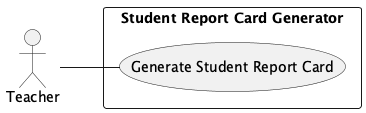
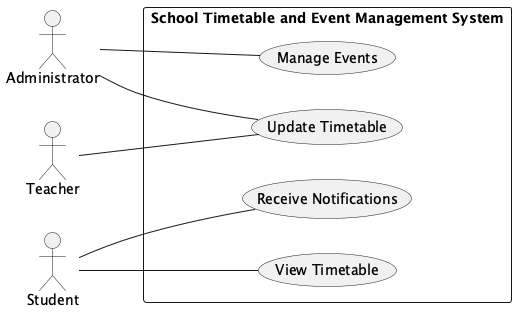
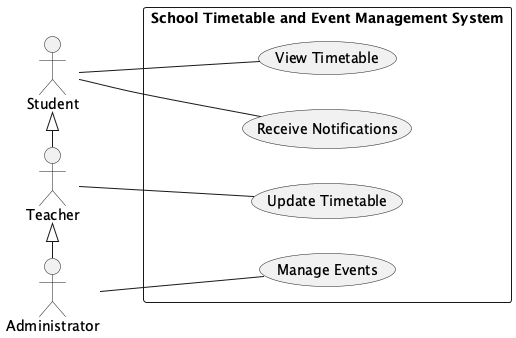
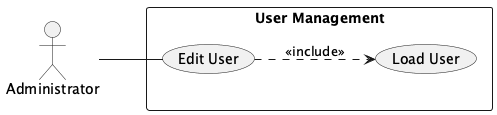
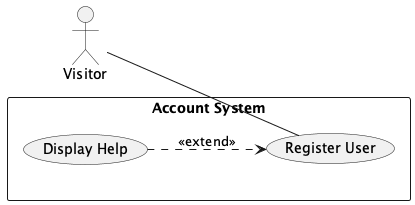
2026-04-28 17:35:38 lisa: Add C02 Use Case Diagram wiki page (5 PlantUML-rendered examples) Page covers actors, use cases, system boundary, and the four relationships (association, generalisation, include, extend), plus arrow-direction rules — the common UCD trap. Five focused PNGs pre-rendered from PlantUML and committed under sd/C02/Use Case Diagram/ (OtterWiki doesn't render PlantUML natively): - 01-base.png — simplest UCD (1 actor, 1 use case) - 02-multi-actor.png — Timetable system, 3 actors, 4 use cases - 03-generalisation.png — Administrator → Teacher → Student - 04-include.png — Edit User --«include»--> Load User - 05-extend.png — Display Help --«extend»--> Register User Blocks used: TIP intro, WARNING for arrow-direction trap, DANGER for common mistakes, SUCCESS for the draw-it order, INFO for the rubric stake. Four-question CYU with spoiler answers. Linked from C02-home under Analytical diagrams.| sd/C02/C02-home.md .. | |
| @@ 19,6 19,7 @@ | |
| - [Context Diagram](/sd/C02/Context%20Diagram) — Yourdon-DeMarco notation, a worked example, "draw it / check it" steps, common mistakes | |
| - [Context Diagram vs Data Flow Diagram](/sd/C02/Context%20Diagram%20vs%20Data%20Flow%20Diagram) — what can appear on each diagram, side-by-side; the most common notation errors in C2-2 | |
| + | - [Use Case Diagram (UCD)](/sd/C02/Use%20Case%20Diagram) — actors, use cases, system boundary, and the four relationships; arrow-direction rules for «include» / «extend» |
| - [What Is an Entity?](/sd/C02/What%20Is%20an%20Entity) — why entities include external systems (APIs, email servers) as well as human users; how to find every entity from your user stories | |
| - [Excalidraw Diagram Starters](/sd/C02/Excalidraw%20Diagram%20Starters) — pre-framed skeletons for all three C02 diagrams (context diagram, DFD, use case diagram) with shape keys and notation checks (DRAFT) | |
| /dev/null .. sd/C02/Use Case Diagram.md | |
| @@ 0,0 1,171 @@ | |
| + | > **DRAFT** — under teacher review. |
| + | |
| + | # Use Case Diagram (UCD) |
| + | |
| + | Hamilton College · Year 12 · 2026 |
| + | |
| + | A use case diagram shows **who** can do **what** with your system. Actors (the *who*) sit outside the system boundary; use cases (the *what*) sit inside. It is the third of the three C02 analytical diagrams and is hand-drawn under timed conditions in the C2-2 validation. |
| + | |
| + | > [!TIP] |
| + | > Most C2-2 marks lost on UCDs come from one of three things: forgetting an actor, putting the system boundary in the wrong place, or pointing the **«include»** / **«extend»** arrows the wrong way. This page covers all three. |
| + | |
| + | --- |
| + | |
| + | ## What it shows |
| + | |
| + | A use case diagram answers two questions in one picture: |
| + | |
| + | - **Who interacts with the system?** (Actors — people *and* external systems) |
| + | - **What can each one do?** (Use cases — functions the system performs for them) |
| + | |
| + | It is **not** a flowchart. It says nothing about the order of actions, the user interface, or how a function is implemented. Save those for other diagrams. |
| + | |
| + | --- |
| + | |
| + | ## The three building blocks |
| + | |
| + | | Element | Symbol | Rule | |
| + | |---|---|---| |
| + | | **Actor** | Stick figure, *outside* the system rectangle | A person *or* external system that interacts with yours. Examples: *Teacher*, *Student*, *Payment Gateway*, *Email Server*. | |
| + | | **Use case** | Oval, *inside* the system rectangle | A function the system performs *for* an actor. Named verb-noun: *"View Timetable"*, *"Generate Report Card"*. | |
| + | | **System boundary** | Rectangle around the use cases | The labelled scope of the software you're building. Actors live outside; use cases live inside. | |
| + | |
| + | ### Worked example: simplest possible UCD |
| + | |
| + | One actor, one use case, one system. *"A Teacher can generate a student report card."* |
| + | |
| + |  |
| + | |
| + | ### Worked example: a multi-actor system |
| + | |
| + | Same notation, more actors and use cases. Each actor has at least one solid line to a use case (an *association*). |
| + | |
| + |  |
| + | |
| + | --- |
| + | |
| + | ## The four relationships |
| + | |
| + | Different lines mean different things. Master these four and you have everything C2-2 needs. |
| + | |
| + | ### 1. Association *(actor ↔ use case)* |
| + | |
| + | **Solid line** between an actor and a use case. *"This actor participates in this use case."* This is the most common relationship — every actor needs at least one. |
| + | |
| + | > *Student ———— View Timetable* |
| + | |
| + | ### 2. Generalisation *(actor → actor, or use case → use case)* |
| + | |
| + | **Solid line with a hollow triangle pointing to the parent.** The child inherits everything the parent can do. Useful for role hierarchies (an Administrator can do everything a Teacher can, plus more). |
| + | |
| + |  |
| + | |
| + | > *Administrator ──▷ Teacher ──▷ Student* |
| + | |
| + | In this example, *Student* is associated only with *View Timetable* and *Receive Notifications* — but because *Teacher* generalises *Student*, a Teacher inherits those associations too. The diagram only draws the **new** associations at each level. |
| + | |
| + | ### 3. Include *(use case → use case, always required)* |
| + | |
| + | **Dashed line with `«include»` label**, arrow pointing **TO the included use case**. *"The base use case **always** does this other use case as part of its work."* |
| + | |
| + |  |
| + | |
| + | > *Edit User ┄┄«include»┄┄▷ Load User* |
| + | |
| + | You can't edit a user without first loading them — so *Edit User* **includes** *Load User*. Every time *Edit User* runs, *Load User* runs. |
| + | |
| + | ### 4. Extend *(use case → use case, optional)* |
| + | |
| + | **Dashed line with `«extend»` label**, arrow pointing **TO the base use case**. *"This other use case **sometimes** runs as an addition to the base."* |
| + | |
| + |  |
| + | |
| + | > *Display Help ┄┄«extend»┄┄▷ Register User* |
| + | |
| + | Help is optional — most users register without ever opening it. So *Display Help* **extends** *Register User*. The base use case (*Register User*) doesn't know or care whether the extension fires. |
| + | |
| + | ::: warning |
| + | **Arrow direction trap** |
| + | |
| + | The `«include»` and `«extend»` arrows point in **opposite** directions. Easy way to remember: |
| + | |
| + | - **«include»** — arrow points to the use case that's being **used by** the base. |
| + | - **«extend»** — arrow points to the use case that's being **added to**. |
| + | |
| + | In both cases, the arrow points *toward* whatever the relationship is *named for*: *include* points at the included; *extend* points at the extended. |
| + | ::: |
| + | |
| + | --- |
| + | |
| + | ::: danger |
| + | **Most common UCD mistakes** |
| + | |
| + | 1. **Actor inside the system boundary.** Actors are *external* — they always sit outside the rectangle. If your stick figure is inside, you've made a notation error. |
| + | 2. **Use case outside the system boundary.** Use cases describe what *your* system does. If an oval is outside the rectangle, it's not part of your system. |
| + | 3. **Pointing «include» the wrong way.** Arrow goes *from* the base use case *to* the included one (Edit User → Load User), not the other way. |
| + | 4. **Pointing «extend» the wrong way.** Arrow goes *from* the extension *to* the base use case (Display Help → Register User). This trips up nearly everyone — practise it. |
| + | 5. **Use cases as nouns or UI elements.** *"Login Page"* or *"Database"* is not a use case. Use cases are **verb-noun phrases** describing what the system *does*: *"Login"*, *"Save Profile"*. |
| + | 6. **Forgetting non-human actors.** A payment gateway, an email server, an external API — all actors. See [What Is an Entity?](What%20Is%20an%20Entity.md) — the same logic applies here. |
| + | ::: |
| + | |
| + | --- |
| + | |
| + | ## How to draw one (the reliable order) |
| + | |
| + | ::: success |
| + | 1. **Identify your actors** — work from your *user characteristics* and your data-collection findings. Don't forget non-human external systems. |
| + | 2. **List your use cases** — translate each *functional requirement* into a verb-noun use case. |
| + | 3. **Draw the system boundary** — a labelled rectangle. Use cases go inside; actors stay outside. |
| + | 4. **Connect actors to use cases** with solid lines (associations). Every actor needs at least one. |
| + | 5. **Add «include» and «extend» relationships** between use cases — only where they genuinely apply. Don't force them. |
| + | 6. **Check arrows.** Walk through every dashed line and confirm direction. |
| + | ::: |
| + | |
| + | --- |
| + | |
| + | ::: info |
| + | **Why VCAA cares** |
| + | |
| + | The C2-2 rubric at **5–6** asks for *"illustrates the relationships between the existing system, entities and data flows"* on the use case diagram. *"Some errors or omissions"* is acceptable at this band. |
| + | |
| + | At **9–10**, it requires *"no errors, inconsistencies or omissions"*. The notation rules above are the difference between 7 and 10 — every wrong arrow direction, every actor inside the boundary, is an error that costs you the top band. |
| + | ::: |
| + | |
| + | --- |
| + | |
| + | ## Check Your Understanding |
| + | |
| + | Answer in your head first, then click the spoiler to check. |
| + | |
| + | **1.** A login system always verifies credentials before granting access. How should this appear on a UCD? |
| + | *(a) Login generalises Verify Credentials · (b) Login includes Verify Credentials · (c) Login extends Verify Credentials · (d) Login and Verify Credentials are independent use cases* |
| + | |
| + | >! **(b) Login includes Verify Credentials.** "Always" is the trigger word for **«include»**. Arrow goes from *Login* to *Verify Credentials* (Login → Verify Credentials). |
| + | |
| + | **2.** A registration form *optionally* shows a tooltip if the user clicks a help icon. How should this appear? |
| + | *(a) Show Tooltip includes Register · (b) Show Tooltip extends Register · (c) Register includes Show Tooltip · (d) Register extends Show Tooltip* |
| + | |
| + | >! **(b) Show Tooltip extends Register.** "Optionally" is the trigger word for **«extend»**. Arrow goes from the *extending* use case (Show Tooltip) **to** the base (Register): *Show Tooltip → Register*. |
| + | |
| + | **3.** Which of these is **not** a valid use case label? |
| + | *(a) Submit Order · (b) Generate Report · (c) Login Page · (d) Cancel Booking* |
| + | |
| + | >! **(c) Login Page.** Use cases are **verb-noun phrases** describing what the system *does*, not UI elements. *"Login"* would be valid; *"Login Page"* describes a screen, not a function. |
| + | |
| + | **4.** An Administrator can do everything a Teacher can, plus extra admin tasks. Which relationship best models this? |
| + | *(a) Association · (b) Include · (c) Extend · (d) Generalisation* |
| + | |
| + | >! **(d) Generalisation.** Administrator generalises Teacher — meaning Administrator inherits all of Teacher's associations and adds its own. Drawn as a solid line with a hollow triangle pointing to the parent (Teacher). |
| + | |
| + | --- |
| + | |
| + | ## See also |
| + | |
| + | - [What Is an Entity?](What%20Is%20an%20Entity.md) — same actor-discovery logic; non-human entities count as actors too |
| + | - [Context Diagram](Context%20Diagram.md) and [Context Diagram vs Data Flow Diagram](Context%20Diagram%20vs%20Data%20Flow%20Diagram.md) — the other two C02 diagrams; entity/actor names should match across all three |
| + | - [Excalidraw Diagram Starters](Excalidraw%20Diagram%20Starters.md) — pre-framed UCD canvas you can use to rehearse before the timed validation |
| + | - [Essential Terms](Essential%20Terms.md) — definitions of *actor*, *use case*, *system boundary*, *include*, *extend*, *generalisation* |
| + | |
| + | --- |
| + | |
| + | ← Back to [VCE Software Development Hub](/sd/VCE%20Software%20Development%20Hub) |
| /dev/null .. sd/C02/Use Case Diagram/01-base.png | |
| /dev/null .. sd/C02/Use Case Diagram/02-multi-actor.png | |
| /dev/null .. sd/C02/Use Case Diagram/03-generalisation.png | |
| /dev/null .. sd/C02/Use Case Diagram/04-include.png | |
| /dev/null .. sd/C02/Use Case Diagram/05-extend.png | |