Commit 5c916b
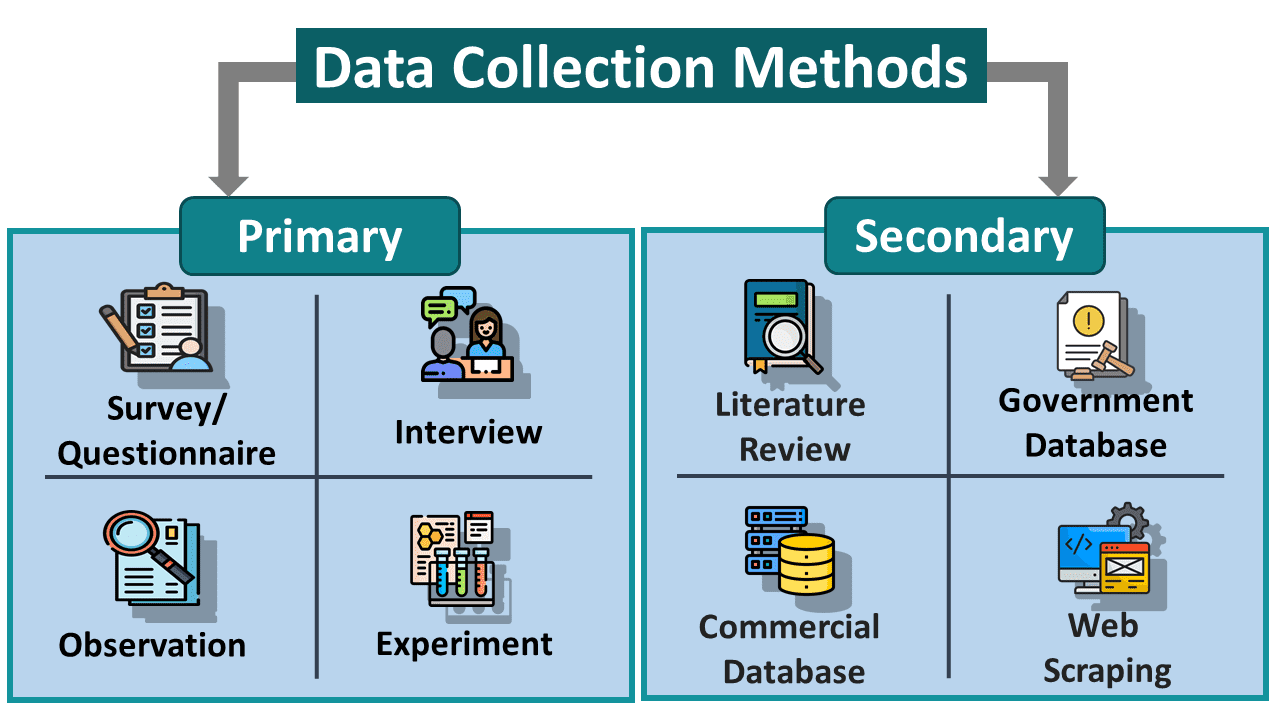
2026-04-27 20:12:13 lisa: Data Collection Methods: add Primary/Secondary diagram + AI examples - Embed Data-Collection-Methods.png (primary vs secondary families) at the top, with a short framing of which 4 we use for VCE SD. - Replace COVID-era real-world examples with current AI-related ones: teachers + ChatGPT (interview), Pew 2024 AI adoption (survey), and GitHub's Copilot productivity study (observation).| sd/C02/Data Collection Methods.md .. | |
| @@ 10,6 10,19 @@ | |
| --- | |
| + | ## The big picture |
| + | |
| + |  |
| + | |
| + | Researchers split data collection into two families: |
| + | |
| + | - **Primary** — data *you* collect, first-hand: surveys, interviews, observations, experiments. |
| + | - **Secondary** — data *someone else already collected*, repurposed for your question: literature reviews, government databases, commercial databases, web data. |
| + | |
| + | For your VCE SD project we use **four** of these — surveys, interviews, observations, and the secondary group bundled together as **reports / existing data**. (Experiments are not a standard SAT method — your project is software design, not scientific research.) |
| + | |
| + | --- |
| + | |
| ## The four methods at a glance | |
| | Method | Best for | Data type | Time cost | Save raw to | | |
| @@ 50,7 63,7 @@ | |
| - Plan **2–4 interviews**, not 10. The C2-1 rubric rewards depth of analysis, not interview count. | |
| >| ### Real-world example | |
| - | >| A 2022 study interviewed 30 families about children's screen time during COVID-19 lockdowns. They found that excessive screen time reduced interest in face-to-face interaction and caused family conflicts — a finding a survey alone could not have surfaced because parents had to think aloud and revise their first answers. |
| + | >| In 2024, university researchers interviewed teachers about how they use ChatGPT in lesson planning. The interviews revealed something a survey would have missed: most teachers used the tool to **draft rubrics and generate question variants**, not to write lesson content directly. They distrusted AI for content but trusted it for structure — a nuance that only emerged when interviewers asked follow-up questions like *"can you walk me through the last time you used it?"* |
| --- | |
| @@ 82,7 95,7 @@ | |
| - Save the **raw CSV export**, not just a summary screenshot. | |
| >| ### Real-world example | |
| - | >| A 2023 England-based study surveyed 7,797 school children about COVID-19 impacts. They found 1.8% of younger and 6.9% of older children experienced persistent problems including anxiety, difficulty concentrating, and sensory loss — a scale of evidence interviews alone could never produce. |
| + | >| Pew Research's 2024 survey of US adults on AI tools reached over 11,000 respondents in a few weeks. They found roughly **1 in 4 adults had used ChatGPT**, with usage skewed strongly to younger and more-educated demographics. That kind of demographic spread can only be established by surveys — interviewing 11,000 people would take years. |
| --- | |
| @@ 113,7 126,7 @@ | |
| - Cross-check observations against interview claims. Contradictions are gold for your poster's *"explaining why"* section. | |
| >| ### Real-world example | |
| - | >| Michigan State University chemists (2023) observed ionic liquids and discovered a piezoelectric material existing in liquid form — previously known only in solids. They were not testing for it; they were watching, and noticed something the established theory said wasn't possible. |
| + | >| GitHub's 2023 controlled study observed developers completing the same coding task with and without GitHub Copilot (an AI coding assistant). Developers using Copilot finished **about 55% faster** on average — a number self-reports would have understated, because developers using AI assistants often *feel* slower (the tool interrupts their flow) even when measurement shows they're producing more working code. |
| --- | |
| /dev/null .. sd/C02/Data Collection Methods/Data-Collection-Methods.png | |