
Workshop 1: Hardware & Networks — Online Companion
This page has the extra stuff that didn't fit in your printed booklet. Videos, interactive links, photo galleries, and deeper explanations for when you want to know more.
Got your booklet? Good. This page goes with it.
Watch: Video Explainers
These short videos cover the same topics as your booklet — watch before class or review after.
Inside a Computer — Why AI Stole Your GPU (1:35)
CPU, RAM, Storage, Motherboard, and why AI needs ALL the GPUs.
How Networks Power AI (1:22)
How your message travels through switches, routers, and undersea cables to reach ChatGPT.
Inspiration videos (from your booklet)
Each video referenced in the printed booklet has its own companion page with the embed, "what to watch for" prompts, and Have-a-Go questions. Open these when you want to go deeper on a topic.
- dt7/Tom Scott - Fetch Execute Cycle (booklet shortlink: way2.cc/ca7) — A relay computer the size of a wardrobe, running the same fetch-decode-execute loop as your laptop CPU. Hear it clack.
- dt7/Crash Course - Binary (way2.cc/ca8) — Carrie Anne Philbin walks you from "binary is just two states" to ASCII, RGB, and why a kilobyte is 1024 bytes.
- dt7/Vox - Undersea Cables (way2.cc/ca9) — 99% of the world's internet runs through cables thinner than a garden hose, sitting on the ocean floor.
- dt7/Raspberry Pi Foundation - What Is A Raspberry Pi (way2.cc/caa) — The official 4-minute tour: Pi family, the $35 charity backstory, real-world projects from weather stations to the ISS.
Try: Interactive Tools
Binary Converter
Type a number and see it in binary — or type binary and see the decimal:
- RapidTables Binary Converter — quick conversion both ways
- CS Unplugged Binary Cards — the dot card activity from class, but online
Network Simulator
- Firia Labs Network Simulator — build a virtual network with switches and routers
- Subnet Game — test your networking knowledge (extension challenge)
Look Closer: Hardware Photo Gallery
Your booklet has diagrams. Here are the real things.
CPU
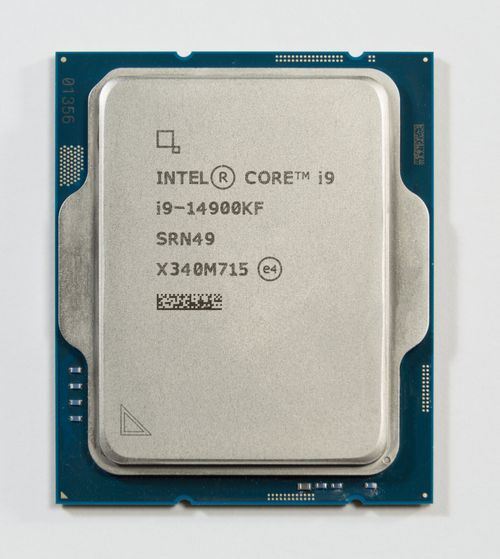
An Intel Core i9-14900KF. Image by Pstrahl, CC BY-SA 4.0, via Wikimedia Commons.

A modern Intel Core i9 processor. The silver square is the heat spreader — underneath are billions of transistors smaller than a virus.
RAM
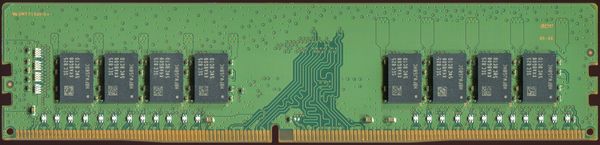
A 16 GiB DDR4 SDRAM stick (Samsung M378A2K43CB1-CTD). Image by PantheraLeo1359531, CC BY 4.0, via Wikimedia Commons.

DDR memory sticks. These plug into the slots on the motherboard. The gold pins are the electrical contacts. More sticks = more "desk space" for your apps.
Storage: SSD vs HDD
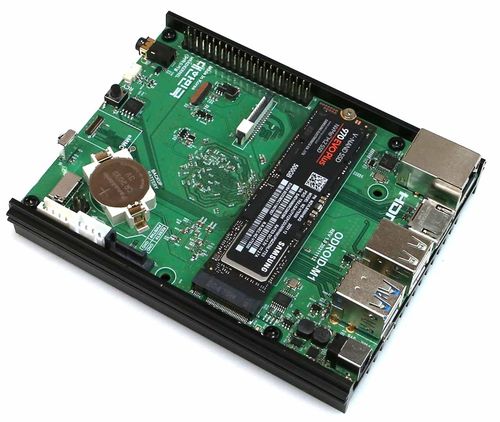
A Samsung 970 EVO Plus NVMe M.2 SSD — the green stick, about the size of a pack of gum. Image by Hardkernel, CC BY-SA 4.0, via Wikimedia Commons.

SSD (Solid State Drive) — No moving parts. Data stored on memory chips. Fast, silent, expensive.
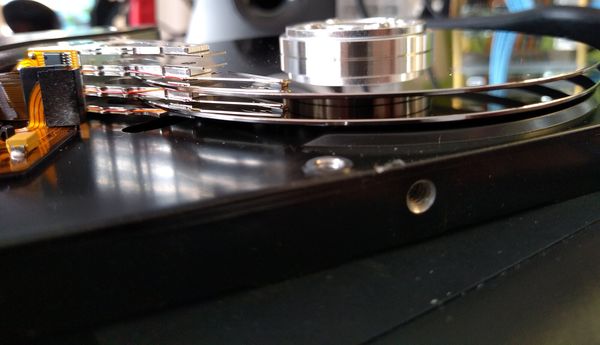
An opened Samsung 8.4 GB HDD — two platters and four read/write heads. Image by Gunnar Wolf, CC BY-SA 4.0, via Wikimedia Commons.

HDD (Hard Disk Drive) — A spinning metal platter with a read/write arm floating above it. Slower, cheaper, still used for bulk storage.
GPU
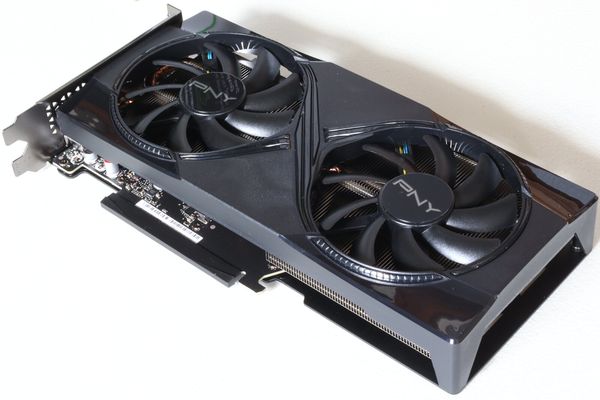
A PNY NVIDIA GeForce RTX 5060 Ti 16GB, front view. Image by FreeMediaKid!, CC BY-SA 4.0, via Wikimedia Commons.

The NVIDIA RTX 5060 Ti — a modern gaming graphics card. Those two black circles are fans that cool the chip during heavy work. AI companies buy millions of these (or the more powerful server versions).
Motherboard
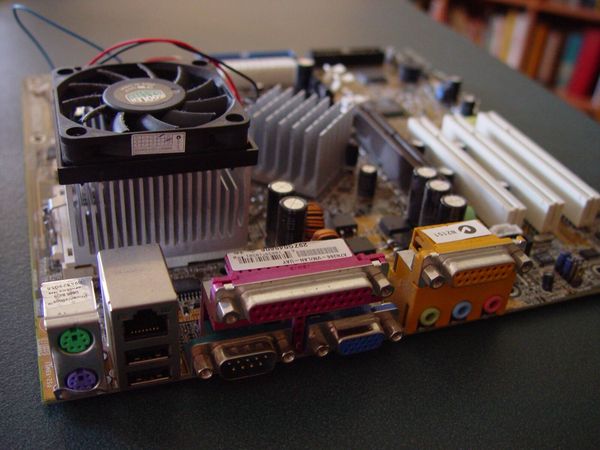
An ATX-format motherboard with CPU and fan installed. Image by Leon Brooks, public domain, via Wikimedia Commons.

Everything plugs into this board. You can see the CPU socket, RAM slots, PCIe slots (for the GPU), and hundreds of tiny traces carrying data between components.
Go Deeper: Things the Booklet Didn't Cover
How big is a transistor?
Modern CPUs use 3-nanometre transistors. A human hair is about 80,000 nanometres wide. You could fit roughly 26,000 transistors across a single hair. The Apple M4 chip has 28 billion of them.
Why do computers use binary?
Because transistors are switches — they're either ON (1) or OFF (0). It's easier to build reliable hardware with two states than ten. Everything else (text, images, video, AI) is built on top of these two states.
How fast does data travel in fibre-optic cables?
About 200,000 km/s — roughly two-thirds the speed of light. A message from Melbourne to London (17,000 km) takes about 85 milliseconds through undersea cables. That's faster than you can blink.
What's inside a data centre?
Thousands of server racks, each holding dozens of computers. Google has over 30 data centres worldwide. A single data centre can use as much electricity as a small city. Most of that power goes to cooling — the chips generate enormous heat.
Why can't gamers buy GPUs?
AI training needs thousands of GPUs running together for weeks or months. Companies like OpenAI, Google, and Meta are buying every GPU they can get. NVIDIA's revenue tripled because of AI demand. The same chip architecture (CUDA cores) that makes games look good also makes AI calculations fast.
Answers: Binary Practice
From your booklet:
| Binary | Decimal |
|---|---|
00001101 |
13 |
01010101 |
85 |
11000011 |
195 |
10000001 |
129 |
| Decimal | Binary |
|---|---|
| 25 | 00011001 |
| 100 | 01100100 |
| 42 | 00101010 |
| 200 | 11001000 |
Check your working: For each 1 in the binary number, add up the place value. For decimal to binary, find the biggest power of 2 that fits, subtract, repeat.
Links for Parents
Wondering what your child is learning? Here's a quick summary:
- Students are exploring how computers work — opening old laptops, identifying components, understanding what each part does
- They're learning binary — the number system computers use (just 0s and 1s)
- They're building networks — connecting devices with real cables and switches
- Everything connects to AI — helping students understand that AI runs on the same hardware they're studying
This aligns with the Victorian Curriculum: Digital Technologies for Years 7-8.
Last updated: April 2026. Questions? Ask your teacher.
← Back to dt7/Year 7 Hub