
DRAFT — under teacher review.
Activity — Design a Hot Cross Bun Matrix
The Hamilton and Alexandra College · Year 12 · 2026
The fastest way to learn how to design an evaluation matrix — and then decide which elements of the winning design need to be developed further — is to build one for something real and edible. CHOICE rates hot cross buns with the same discipline it rates headphones; in this activity, so will you. By the end you'll have designed, run, defended a matrix and produced a "further develop" list — the exact deliverable for C4-2 and Unit 4 Outcome 1.
CHOICE's actual hot cross buns review-and-compare is the reference matrix you're learning from.
🎯 Watch first: notice the panel scores against agreed criteria. Your job today is to decide those criteria — and defend them.
The challenge
We're comparing two real CHOICE-reviewed buns — Woolworths Bakery Chocolate vs Coles Finest Luxurious Fruit. Working as a review panel, you will:
- Design an evaluation matrix.
- Use it to crown a winner.
- Decide which elements of the winning bun design need to be developed further — including elements your matrix did not score.
That third step is the headline skill for C4-2. It's the harder one — and the one most students skip.
Step 1 — Read CHOICE's matrix
We're not starting from scratch. CHOICE ran an actual review in March 2025 — a blind taste test of 19 supermarket and bakery buns. Two of their top picks are on the bench:
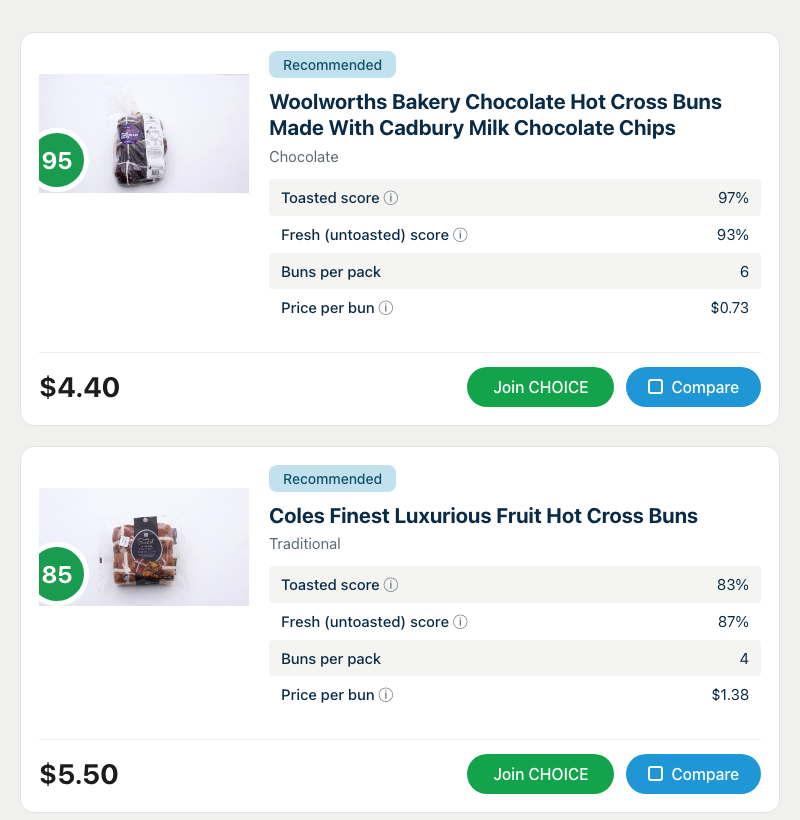
| Product | CHOICE Rating | Type | Toasted | Fresh | Buns/pack | Price/bun |
|---|---|---|---|---|---|---|
| Woolworths Bakery Chocolate (Cadbury chips) | 95 | Chocolate | 97% | 93% | 6 | $0.73 |
| Coles Finest Luxurious Fruit | 85 | Traditional | 83% | 87% | 4 | $1.38 |
Source: CHOICE Hot Cross Buns review and compare, last updated 20 March 2025. Card layout, data and product photography reproduced from CHOICE for educational analysis.
Check Your Understanding
What is the score of 95 calculated for Woolworths Bakery Chocolate?
...
The CHOICE Expert Rating is the average of the Toasted and Fresh scores.
Woolies: Toasted 97%, Fresh 93% → (97 + 93) ÷ 2 = 95. Cross-check on Coles: Toasted 83%, Fresh 87% → (83 + 87) ÷ 2 = 85. ✓
Three things this tells you about CHOICE's matrix:
- Toasted and Fresh are weighted 50/50 in the Expert Rating.
- Price per bun is not in the Expert Rating — CHOICE shows it on the card but doesn't fold it into the headline score.
- Buns per pack is nowhere in the calculation — which confirms why it isn't really a criterion.
The CHOICE cards show two things at once: a matrix and scores.
The matrix — which criteria exist, the weights, the formula behind the Expert Rating — is what CHOICE designed before tasting any buns. That's the equivalent of your C4-2 checkpoint: you build the matrix and defend it.
The scores — 97%, 93%, 85, 95 — get filled in afterwards, when real products are run through the matrix. That's your validation: evaluating a finished solution against the matrix you designed.
One artifact, two jobs — and the matrix has to exist before the scores can mean anything.
Step 2 — What is your matrix built for? (your SRS)
Before you taste anything, notice what's already obvious: these aren't the same product. One is chocolate, one is traditional fruit. One is $0.73 per bun, the other $1.38 — nearly double. CHOICE's Expert Rating crowns Woolies Chocolate (95) over Coles Fruit (85). But that ranking came out of CHOICE's matrix for CHOICE's view of "best hot cross bun" — and your persona is not CHOICE.
Criteria come first, never invented afterwards to crown the bun you happened to like. Working from the seven design decisions, agree on:
- Who you're recommending for — the persona drives everything. "Best bun for a family's traditional Easter breakfast" and "best bun for the kids' lunchbox snack" will not pick the same winner.
- Your criteria — the handful that decide it for that person. Watch out: some criteria (like "traditional fruit & spice flavour") really only apply to one of these two buns. Decide upfront whether you score that as 0–1 for the chocolate bun, or exclude it because your persona doesn't demand it.
- How each is measured — blind panel rating for the eating qualities. The CHOICE data above is legitimate input for value, price, and a sanity check on toasted/fresh.
- Weights, justified — where your point of view lives.
- A scale (use 0–5).
- What you deliberately exclude, and why — flag these now; they come back in Step 5.
Step 3 — Taste blind, score independently
Two habits that are real evaluation skills, not just fairness:
- Blind it. Label the brands A, B, C with the names hidden. If you can see the brand, the brand scores it for you.
- Score alone first, then compare. If everyone just agrees with whoever speaks loudest, you've measured confidence, not buns.
Apply your weights to each brand's scores to get a weighted total.
Step 4 — Crown the winner
- Explain which bun proceeds, citing at least two criteria and their scores.
- Justify by naming the rival: what does your winner give up compared with the runner-up, and why is that trade-off worth it for your persona?
Step 5 — Decide what to develop further
You now know which bun wins. The harder question — the C4-2 deliverable — is: which elements of that winning design need detailed design work next?
The matrix on its own doesn't answer that. Look in two places:
(a) Where your winner scored weakest. If your winner beats the rivals overall but only got a 3 on texture, that is a development priority. The detailed-design task isn't "is the texture good enough?" — it's "how will we improve texture in the next version?"
(b) Requirements the matrix didn't score. This is the bit students miss. The matrix scores criteria the persona uses to choose between options — taste, value, freshness. But your project has requirements that don't decide one bun over another, and so don't earn a matrix row, yet absolutely affect the final product. Packaging is the classic case:
The requirement "attract more customers to consider buying it" is real — but packaging doesn't change how the bun eats, so it stays out of the matrix. It still has to be designed properly. It belongs on your "develop further" list anyway.
A quick test for any candidate element:
"If two designs tied on this, would it show up in the matrix?" If no, but it still has to be designed properly, it goes on your develop-further list.
Now produce three things to develop further — at least one from (a), at least one from (b).
In C4-2 this is the headline output. The matrix names the winning idea; the deliverable is which elements of that idea become detailed designs. Packaging-not-in-matrix is your worked example of source (b).
Your scoring sheet
| Criterion (weight) | Method | Woolworths Bakery Chocolate | Coles Finest Luxurious Fruit |
|---|---|---|---|
| Weighted total / 5 |
To develop further:
- (from (a) — a matrix-scored criterion the winner is weakest on)
- (from (b) — a requirement the matrix didn't score, e.g. packaging)
- (your call — either source)
Why this matters
The buns are a stand-in. The design decisions are identical when you evaluate your own software design ideas in C4-2. The matrix tells you which idea proceeds; the develop-further list tells you what your detailed design has to do. Both come out of this one activity.
See also
- Designing an Evaluation Matrix — the seven design decisions in full
- CHOICE Headphones — Spotting Efficiency and Effectiveness — the same matrix discipline applied to a software-flavour example
- C4-2 Checkpoint — Your Evaluation Matrix · Efficiency vs Effectiveness
- Reference: CHOICE hot cross buns review-and-compare
← Back to C04 Home · VCE Software Development Hub